Sunday, 24 March 2013

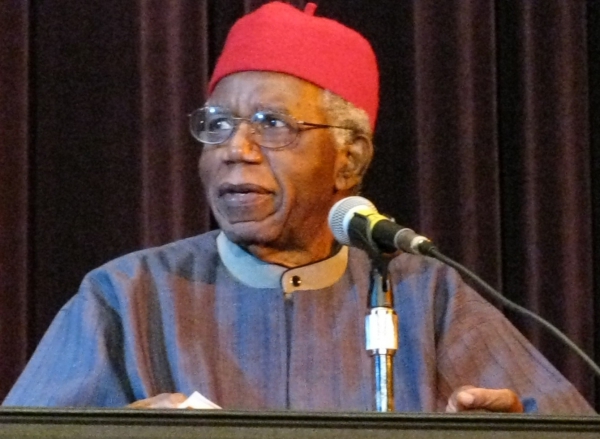
Chinua Achebe Dies Aged 82: The Extraordinary Life and Work of an Extraordinary Man


Chinua Achebe will be sorely missed

In 2008, while studying for my Postcolonial Literature module at Manchester Metropolitan University, I read Chinua Achebe’s “A Man of the People”.

Finding the book a short but fascinating introduction to an author who my course tutors seemed to adore, I set about reading the better known “Things Fall Apart” over the following summer.

As “Things Fall Apart” has been described by Achebe himself as a ‘spiritual predecessor’ to “A Man of the People” and to several of his later novels, I found myself delving backwards through the work of a man who characterised African literature in the 20th and early 21st centuries.

On Thursday, Chinua Achebe died in Boston, Massachusetts after a short illness. Born in Ogidi in the Protectorate of Nigeria in 1930, Achebe spent the first 24 years of his life under British colonial rule, until the disbandment of the colony in 1954. By this point, Achebe had studied at Nigeria’s first university – University College in Ibadan – achieving a second class degree.

While not excelling academically – not yet, anyway – Achebe did find the time to fall in love with literature at the university, something which we should all be thankful for.

Four years after Nigerian independence, Achebe published his debut novel, “Things Fall Apart”, followed by “No Longer At Ease” two years later and then an extensive period of travelling. On returning to Nigeria, he set about creating the Voice of Nigeria network, nurturing and encouraging the cultural identity of this fledgling, independent nation.

Over the years that followed, Achebe produced three more novels, as well as countless short stories, poems and works of critical and political theory. The great man will be remembered as a novelist, but – amongst the fiction – it was one of his works of academia that resonated most greatly with me.

“An Image of Africa” is Achebe’s essay on the depiction of his home continent in Joseph Conrad’s 1899 novella, “Heart of Darkness”. Often appearing in the upper reaches of those irritating “Best Books Ever” lists, Conrad’s work has been held up as a stunning psychological study of the human mind as it retreats into a sort of Freudian ‘other world’; heading, quite literally, for the heart of darkness.

Achebe instantly dismissed the legitimisation of Conrad’s writing as a modern or pre-modern text. He pronounced that there was something altogether more disturbing about Conrad's work than what initially met the eye, and advocated that it was the author himself himself who should be subjected to psychological study;

"Conrad had a problem with niggers,” Achebe wrote.

“His inordinate love of that word itself should be of interest to psychoanalysts.”

Published as part of the 1988 collection “Hopes and Impediments”, “An Image of Africa” could easily have become an interesting, if rather pedestrian, historical assessment of a hoary old Victorian writer and his problem with “those black chaps”. However, Achebe’s keen sense of social and political relevance ensured that the essay offered far more than this.

He maintained that, by simultaneusly holding up an outdated text like this one as a paragon of its literary movement, and apologising for its often less-than-salubrious messages, we are simply perpetuating support for prejudice, subjugation and segregation; attitudes that we like to think we have left behind.

When we cite works like these as foundation texts upon which modern literary schools of thought are based, this practice becomes all the more dangerous.

Achebe argued that, in Conrad’s eyes, notions of African humanity should be dismissed, and the continent should instead be viewed as a sort of experimentation chamber within which the refined European psyche could be put to the test.

"Can nobody see the preposterous and perverse arrogance in thus reducing Africa to the role of props for the break-up of one petty European mind?" Achebe asked.

Who else could produce such a politically charged, powerful and contemporaneous analysis of a book written almost a century before?

Chinua Achebe will be sorely missed. Read his novels, by all means, but do not overlook “An Image of Africa”, a text that did as much to promote African culture and literature in the international consciousness as the celebrated “Things Fall Apart” or “Anthills of the Savannah”.

RIP.

Nicola Monaghan, Alan Sillitoe and Nottingham’s Literary Soul


Nottingham on a rare sunny day

Nottingham is a city with soul. 

This is a non-negotiable position, and one which is soon reached by anyone who has spent time in the East Midlands conurbation.

It’s got its problems, like anywhere. But, time and time again, its positives outstrip its negatives, both in number and in weight.

Ask someone to describe Nottingham’s literary soul in two words, and the answer that is likely to be fired back your way is: 'Alan Sillitoe'. 

This is unsurprising: the author's scintillating work “Saturday Night, Sunday Morning” continues to reverberate in every drunken laugh that echoes out at 3am on Forman Street and Broad Street to this day.

To paraphrase the Arctic Monkeys – somewhat appropriately, given the Sheffield quintet’s admiration for Sillitoe’s novels – there is a certain romance in the next generation of Nottingham’s youth emulating Arthur’s adventures on the cobbles of Old Market Square each weekend. How accurate they make such emulations is up to them.

So, while Sillitoe is the undisputed grand master of Nottingham’s literary scene, and is immortalised at the heart of the city’s cultural soul; who are the young writers ready to take up that torch and forge on into the 21st century?

Writers like Ghanaian-born, Freddy Fynn have already helped to expand the traditional boundaries of Nottingham’s literature.

His outstanding collection “Of Life and Love: Eight Moral Tales” retells traditional African short stories handed down by Fynn’s grandfather, and could not be set further from NG1 if it tried. Despite this, Fynn’s book instantly became part of the cultural fabric of the East Midlands city.

If writers like Fynn are taking Nottingham in new and exciting directions and introducing fresh perspectives, it is writers like Nicola Monaghan who are continuing the Sillitoe lineage and drawing influence directly from the city of Nottingham, from the ground upwards.

The influence of Alan Sillitoe is evident throughout Monaghan’s work. Even the title of her blog “The Loneliness of the Long Distance Writer”, owes a debt to the famous author, while her short story “Sunday Night and Monday Morning” offers more than just a gentle nod in his direction.

Published in 2006, Monaghan’s award winning debut novel “The Killing Jar” follows young Kerry Ann Hill as she grows up on a council estate in Aspley, north-west Nottingham. Certainly not a love letter to the city, “The Killing Jar” contains some of the most hard-hitting writing and bleak subject matter produced by a British writer in recent years.

The book’s central metaphor is its eponymous killing jar. Used by Kerry Ann’s elderly neighbour, Mrs Ivanovich to kill butterflies for her collection, the jar becomes a symbol, not only for the drug-infested council estate, but also for Kerry Ann’s poisonous relationship with her mother and, later, her abusive partner, Mark.

Tackling these issues head on makes “The Killing Jar” uncomfortable reading at times, but there is a thread of positivity that runs throughout the book that prevents the novel becoming an ‘it’s-grim-up-norf’ caricature of itself. Without giving too much away, it is this antithesis of the positive, the uplifting and the downright horrible, that makes the book so readable.

With a keen eye and ear for what makes her city tick, Monaghan's “The Killing Jar” is a triumphant text that repeatedly lays bare the foundations of Nottingham’s strong identity, for better or worse. With that identity brought under scrutiny so often over the last decade, we need texts like this to preserve and propagate it.

Monaghan followed up her debut by moving on to pastures new and producing “Starfishing” – a dark tale of corporate excess set in The City in the boom days of the late ‘90s – and “Okinawa Dragon”. I have to admit that I haven’t read either novel, although I will do someday. However, I go about my day with constantly crossed fingers in the hope that Nicola will return to our shared hometown for her next literary outing.

In the meantime, I continue to be quietly overwhelmed with civic pride.

Click here for an exploratory journey around Nottingham's oldest pubs.

Thursday, 14 March 2013

Fellow readers; how much guidance do we really want? Or need?


It has little to do with the remainder of this post, but it is a fact that Russian literature is something I can get enthusiastic about. 

Today I decided to search for my next literary fix from the former Soviet republic and found myself reading through the Amazon user reviews for Dosoyevsky’s “The Devils” (aka – for the sake of accuracy – “Demons” or “The Possessed”).

The only review I could for Dostoyevsky’s 1872 novel which did not offer a glowing 5/5 write up was a one awarding the book a paltry 3/5. The main gripe that his reviewer had with “The Devils” was the reluctance of the author to give the reader any concrete details in terms of character development and back-story.

The discussion raged in the comments, with defenders of Dostoyevsky praising the literary maestro adoptions of narrative ambiguity as to the origins of the characters.

One supporter in particular seemed ecstatic about the way in which the author posed certain questions: how did such-and-such character get here? for example, what are they planning? what is real and what is not? These are questions which Dostoyevsky leaves for the reader to answer. Something that evidently rankled the poster of the 3/5 review.

This interesting point led me to pose a question of my own. As no novelist approaches a work with a completely open and objective mind, should the writer lead his or her readers through the novel, to the conclusion they intended? Or should they cede some degree of narratorial control to the reader themselves?

Acolytes of Roland Barthes’ literary criticism will have a very short answer to this question: it is not up to the author, the author is metaphorically dead – or quite literally dead in the case of Dostoyevsky.

While I prescribe to this view to an extent, it is too neat to completely remove the author from the equation. Novelists are narcissistic by their very nature, and so are understandably reluctant to simply release their creation into the world with no guidebook to help a reader navigate its pages.

So it is interesting when a writer appears to be trying to do just that. Milan Kundera is a writer who has been described variously as narcissistic and even misogynistic – we won’t go into that here, there’s not time – but in his 1979 book, “The Book of Laughter and Forgetting”, he appears to be willing to put his egocentrism to one side, opting to hand over elements of control to the reader themselves.

The narration takes the form of a series of discrete, seemingly unrelated components, which ultimately spiral in on themselves to form a whole. The novel has been described as ‘a whirlwind dance’ – a phrase which echoes the rings of floating dancers that appear at various points in the novel, whether in the skies above Prague or levitating above the floor of a classroom.

However, despite this apparently meticulous choreography, the breathing space given to the reader allows us to form our own connections, formulate our own back-stories and, crucially, draw our own conclusions.

While Kundera’s work is at times dazzling (and at other times frustrating) his techniques are neither experimental nor extreme when compared to the work of certain other postmodern reader. Published a decade prior to Kundera’s work, B.S. Johnson’s “The Unfortunates” is one of the arch examples of a pure rejection of accepted narrative forms.

The novel follows a sports writer who journeys to an unnamed city in the English Midlands (a thinly disguised version of my beloved home town of Nottingham) to cover the match of an unnamed football team (it’s Forest; not County).

Already scoring big in my book on the strength of the setting alone, “The Unfortunates” clinches the winner by virtue of its astonishing disregard for traditional convention. In a move that would have made Gustave Flaubert turn in his grave, Johnson published the novel as a box of 25 un-ordered chapters of various lengths.

The chapters were designed to be read in any order the reader desired, ensuring that any one reader’s experience of the now infamous ‘book-in-a-box’ would be totally dissimilar to that of another.

A victory, then, for those Barthesian literary anarchists who believe that authorial jurisdiction ceases when the pen leaves the paper? Well, not entirely; “The Unfortunates” is packaged up with a proviso that, once again, casts everything into doubt.

B.S. Johnson designed his ‘book-in-a-box’ so that only 23 of the 25 chapters were to be read in the reader’s chosen order. The novel’s opening and closing chapters are clearly demarked as such, acting as carefully inserted bookends to this groundbreaking novel.

So, if even an arch-experimentalist like B.S. Johnson was reluctant to completely cede all control of his narrative, what hope is there for a work which completely eschews traditional for and structure?  Can a novel ever be truly free of the ‘tyranny’ of its author? And – more pressingly – should it ever be released in this way?

I began this post with a question, and ended it with one. Sorry about that.

Sunday, 20 January 2013

Eric Arthur Blair: The Death of Idealism

Eric Arthur Blair - tallest figure - poses with the POUM militia. His wife Eileen O'Shaughnessy Blair crouches beside him.
Tomorrow, Eric Arthur Blair will have been dead for 63 years. Better known to most as George Orwell – prolific author, journalist and thinker – Blair contributed a great deal to our national literary consciousness, even adding a few new words and phrases to our language along the way. But I’m not here to wax lyrical about George Orwell – there are plenty of writers who are in a better position to do so – instead I want to illustrate what the man and his work means to me. My favourite George Orwell work is “A Homage to Catalonia”. Published in 1938, the book details its author’s involvement in the civil war in Spain, a conflict which was still raging at the time of “A Homage…”’s release and one which was continuing to set the tone for the dark years that would follow in the continent’s history. As someone who is fascinated both by the Spanish Civil War and by Orwell’s politics, I decided to read the book ahead of a one month trip that would be spent exploring Portugal and Spain. I had – rather naively – viewed the Spanish Civil War as one of the last truly great ideological struggles; a crusade to which idealists with strong views and the moral character to back them up flocked from all over Europe. Reading the book, I began to doubt this assertion. I began to doubt whether any conflict in the history of mankind could ever be defined as a “truly great ideological struggle.” Without giving too much away, the book follows an idealistic Orwell as he heads to Barcelona and joins up with the POUM socialist militia. Using Orwell’s own experiences of the alternate horror and tedium of life on the frontline, the book becomes a stunning piece of proto-gonzo journalism. Through the author’s eyes we are able to witness the two totemic Republican powers – the anarchists and the communists – grow increasingly distrustful of one another. In a piece of narration that is almost too convenient to be true – although not, I would imagine, particularly convenient for Orwell himself at the time – the author returns from the rugged frontline at Jaca in search of some much needed r’n’r in Barcelona, only to discover that the city has been torn in two by fighting between the anarchist CNT and the communist UGT factions. Orwell – although then more ideologically more aligned to the anarchists – takes up arms with his comrades in the communist POUM, defending their headquarters from the chaos unfolding around them. I won’t give away too much more; “A Homage to Catalonia” is a wonderful book and I urge you to read it for yourself. For me, it permanently altered the way in which I view politics and even the way I approach the study of history. To say it has influenced my life would be an understatement. There is far more in Eric Arthur Blair’s back catalogue to amaze and excite readers – just as there are far more expansive pieces of writing on the civil conflict in Spain – but as a starting point, a reader cannot go far wrong with “A Homage to Catalonia”.

Sunday, 6 January 2013

Gate Way Books

When I was a child I read, a lot. Nothing in particular, just whatever I could get my hands on. Then, I became a teenager, discovered drinking and other such evils, and gradually I stopped reading.
It wasn’t a conscious decision, it was just that one day I discovered that I didn’t have the time to do all the things I wanted to do in that day, and so it was reading that was cut from the schedule.
When I was 18 and getting ready to go to University, I found a book in Eastwood Library, Nottinghamshire that brought reading well and truly back into my consciousness. That book was "M/F" by Anthony Burgess.
Those who are unaware of "M/F" will surely be aware of Anthony Burgess’ more famous work “A Clockwork Orange”. “M/F” is an altogether weirder proposition and, while it lacks the full-blooded violence and darkness of Burgess’ earlier work, its bizarrely Oedipal, carnivalesque characters and situations come together to form a truly nightmarish atmosphere wholly unto itself.
The protagonist, Miles Faber – himself a sort of Caulfield-esque college dropout – finds himself on a nightmarish pilgrimage across the Caribbean in pursuit of the poet Sib Leguru, his intellectual idol and muse. On his travels he meets a bizarre lion-headed man, a bird woman, and his freaklike estranged twin Llew – events which are played out in front of the backdrop of a noisy, frightening and chaotic West Indian carnival.
Freudian in almost every sense, the book draws upon evocations of the ego and the id, as well as the power of childish nightmares and even the more incestuous aspects of Dr Sigmund’s philosophies. But while freakish and labyrinthine are two words often used to describe this book, it remains the book that caused me to fall back into love with literature, and for that I am eternally grateful.
Of course it “lead me onto harder stuff”, but had this not have occurred, god knows what I would have been doing right now instead.
What were the “gate way books” that got you back into reading after a long period of literal-inactivity? Let me know…

The International Anthony Burgess Foundation hosts We4Poets Live this November. Click here for more info.

Daily Mail Proclaims YA Fiction “Sick”


Never ones to shy away from a ‘morally outraged’ headline, the Daily Mail recently ran a story about the ‘evils’ of young adult books that have the audacity to tackle weighty themes, or worse, themes which are important to their target audience.

Tanith Carey, writing for the Mail, described the plotlines of books like “The Fault In Our Stars” – a bestselling children’s novel centring on a 13 year old cancer sufferer – and “Thirteen Reasons Why” – a book dealing with the suicide of a young teenage girl – as “mawkish” and “distasteful”, evidently decreeing them to be unsuitable reading material for members of our fragile younger generation.

I wonder what it is in particular about these subjects that Tanith Carey finds so obscene. Scanning her article in the Mail, I can only conclude that it is their realism that she finds so shocking; the fact that – at some point in most of our lives – we are going to have to confront these things head on.

What the author seems not to recognise – or to wilfully ignore, depending on your viewpoint – is that these issues are real issues for youngsters as well as for adults. Rather than allowing children to use literature to negotiate and work through these themes in a Bakhtinian sense, Tanith Carey would sooner see them not explored at all.

Carey also calls upon two of the traditional tenets of the Daily Mail’s canon of immorality: “sex” and “foul language”. Anyone who thinks that sex and swearing are somehow beyond the radar or vocabulary of an average teenager has been reading too much “Just William”.

So what exactly is Carey’s point? That children’s fiction should deal only with football and adventuring for boys and ponies and light romance (no sex) for girls? Surely Carey realises that modern teenagers have bank accounts and internet access; any child with the inclination could easily pick up “American Psycho” from Amazon, or find something far darker on the internet itself.

Or is Carey trying to make the point that the regulatory codes governing the publishing industry are not stringent enough to protect our youngsters? Maybe, then, children should not read at all until certification falls into line with that of films and video games.

The fact is, under close scrutiny, it becomes abundantly clear that Tanith Carey does not have a coherent point at all. Instead this is just another story of faux moral outrage that the Mail concocts every now and again to give their strait-laced, Audi-owning readers heart palpitations over breakfast.

Don’t let the Daily Mail’s insincere moral crusading guilt-trip you into thinking you’re in some way a bad parent because you let your 13 year old read a book about cancer, and don’t let the Mail’s kneejerk censorial attitude dictate what you or your children read.